
Her på Blåvand's blog bringes korte nyheder i dagbogsformat om livet og hændelser på fuglestationen.
-
FORSIDE

- Blog
Another rainy morning
torsdag 14. maj 2026
Observations:
It rained early this morning. Henrik and I waited for the showers to stop before going to the dunes. The number of migratory birds was good today - the migration trend is indeed slowing down for the season -.
We spotted 211 red-throated loons [rødstrubet lom], 87 northern gannets [sule] and 143 common terns/arctic terns [fjordterne/havterne].
We also saw 2 arctic skuas [almindelig kjove] - dark morph - heading north ! My last skuas of the season because i'm leaving n the 16th, so it was a nice bye-bye gift :))
Todays observations can be seen here.
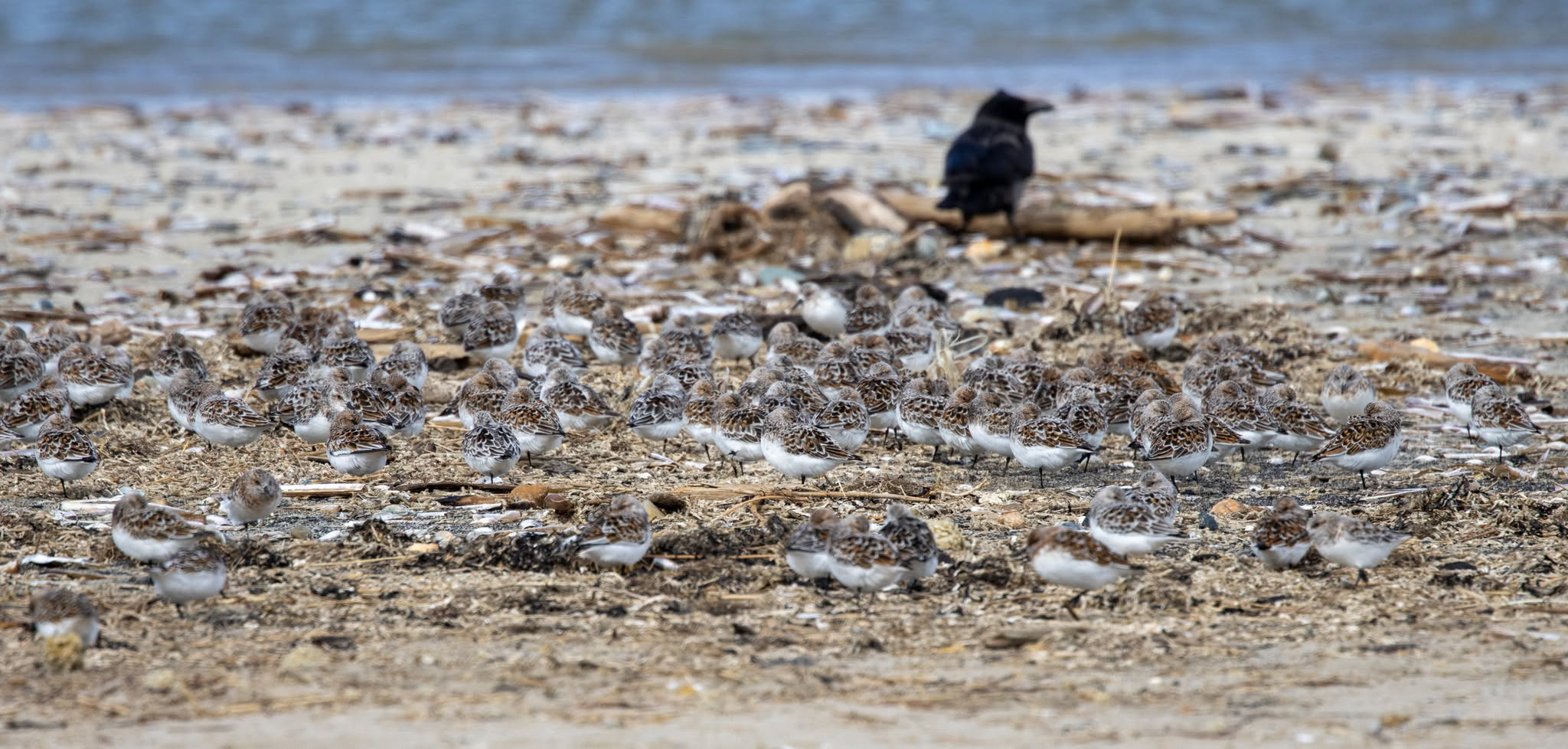
Flock of sanderlings [sandløber] in their breeding plumage and a crow at the back. Picture by Henrik Bøhmer
Ringing:
The nets had to be opened late this morning again due to the rain, but in the end Xenia and I still had a pretty good ringing morning. The total number of birds is slightly up today, with a rather big amount of recaptures which is interesting. The variety of species was the highlight of the day though, with some Bullfinches (Dompap), Wood Pigeon (Ringdue), or a beautiful female Goldfinch (Stillits).
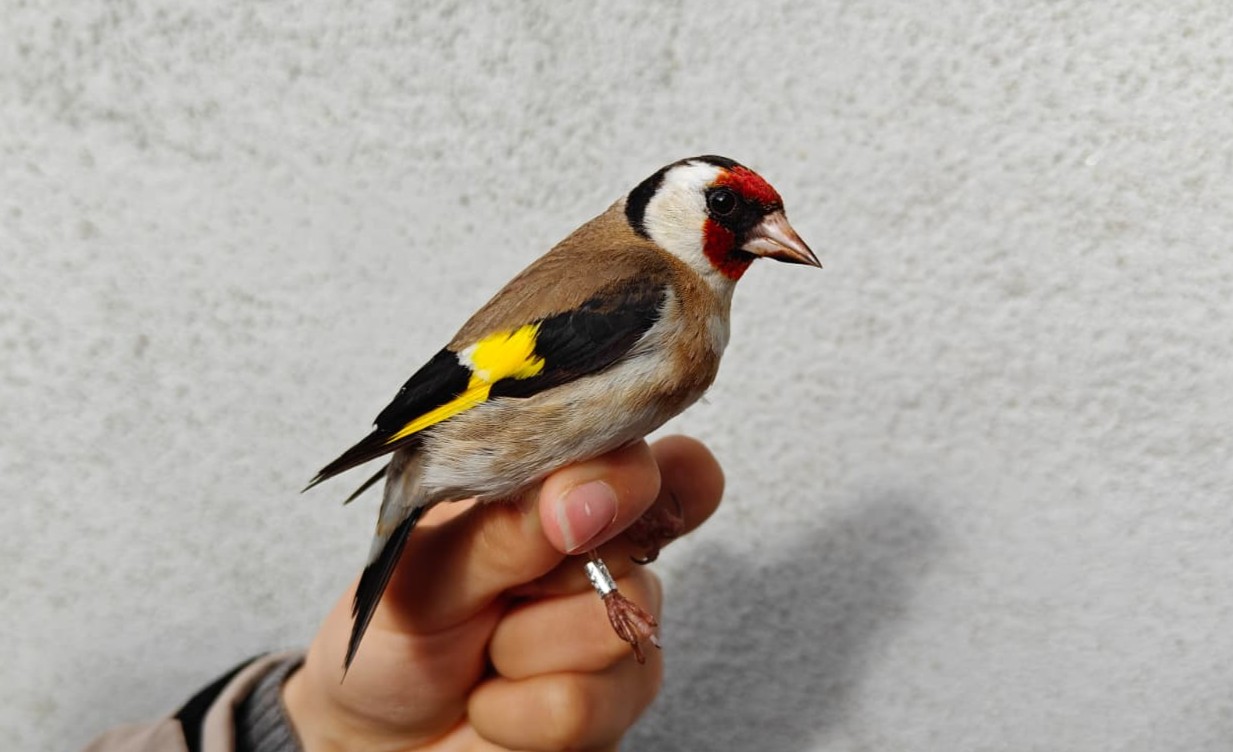 Female Goldfinch (Stillits), Picture Alix
Xenia had a wish of catching some Lesser Whitethroats (Gærdesanger) and Common Whitethroats (Tornsanger), which she did, so that was very nice! They can be quite tricky to age at this time of year, so it’s always good with some practice.
Ringing totals for today:
Ringdue (Wood Pigeon): 1
Solsort (Blackbird): 0/1
Gærdesanger (Lesser Whitethroat): 2/2
Tornsanger (Common Whitethroat): 1/1
Gransanger (Chiffchaff): 1
Løvsanger (Willow Warbler): 2/1
Bogfinke (Chaffinch): 0/3
Stillits (Goldfinch): 1
Dompap (Bullfinch): 2
Total: 10/8
Little tern project:
Today, i could finally do another observation for the Little Tern project. The weather wasn’t great, with strong winds of 8 m/s and quite a bit of cloud cover. This, combined with the fact that there were no little terns again, made for a long and cold observation. The only birds using the fence were three Common ringed plovers exhibiting roosting behavior.
Later in the morning, Joseph visited the exclosure to measure the sand drift that had build up over the past few weeks. After that was done we set up a total of 15 artificial nests at three locations. We distributed these across three sites, spanning five different habitat gradients. Every nest consists of 2 Quail- & 1 wax egg. The purpose of the nests is to see how quickly and by which animals they are preyed upon. I will be checking up on these every two days over the coming weeks. We also placed 3 wildlife cameras, one in every location, to hopefully capture some good footage.
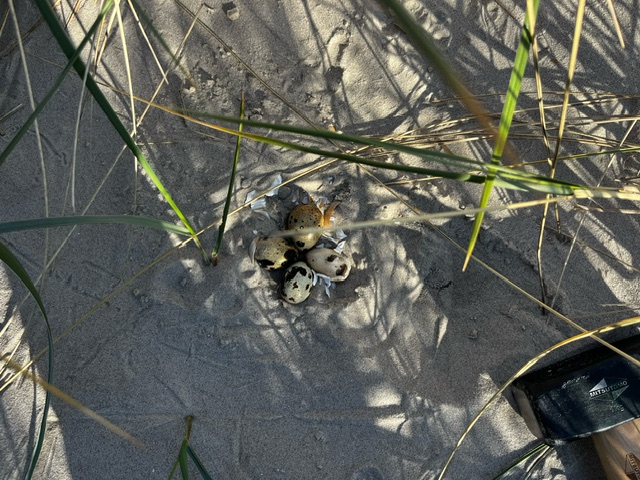
Picture of an artificial nest we made with a wax egg in the middle. Picture by Jorn de Jong
At the station: Alix Bortolussi, Clara Delhaye, Jorn de Jong, Joseph Stephan, Henrik Böhmer & Xenia